
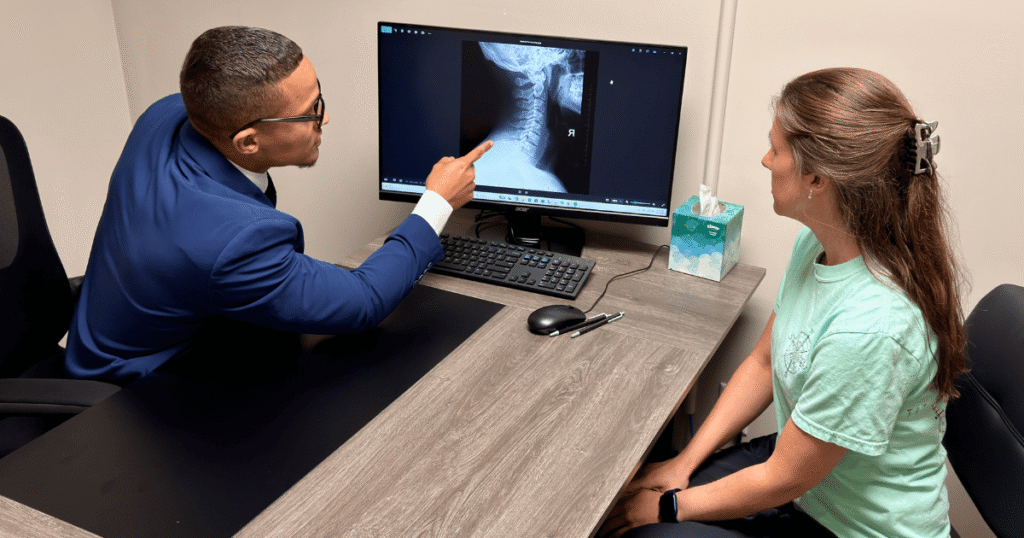
Do You Need an X-Ray for Neck or Back Pain?
If you are experiencing neck pain, back pain, or stiffness, you may wonder whether you need an X-ray to find out what is happening. An X-ray can provide useful information about certain bones and spinal structures, but it is not necessary for every person with neck or back discomfort.
The decision to get a spinal X-ray should depend on your symptoms, medical history, physical examination, and whether the results are likely to affect your care. For many people with uncomplicated lower back pain, imaging is not routinely needed at the beginning of an episode. Source: American College of Radiology and RadiologyInfo.org.
At Victory Spinal Care in Melbourne, Florida, understanding your concerns and reviewing your health history are important parts of an individualized evaluation. If imaging is being considered, it is reasonable to ask what information it is expected to provide and how the findings will be used.
What Does a Spinal X-Ray Show?
A spinal X-ray uses a small amount of ionizing radiation to create images of the bones in your spine. Depending on the area examined and the images taken, an X-ray may help a qualified healthcare professional evaluate certain structural concerns.
Spinal X-rays may help identify or assess:
- Bone alignment: The position and relationship of visible spinal bones.
- Certain fractures: Some breaks or injuries involving the vertebrae.
- Degenerative changes: Certain age-related changes involving bones and joints.
- Curvature or structural differences: Some variations in spinal shape or alignment.
- Other visible bone abnormalities: Findings that may warrant further evaluation.
However, an X-ray does not show every structure in the spine equally well. It does not provide the same detailed view of discs, nerves, and other soft tissues that may be available through magnetic resonance imaging (MRI).
An X-ray also cannot, by itself, explain every cause of pain. Imaging findings must be interpreted alongside a person’s symptoms, examination, and medical history.
When Might a Spinal X-Ray Be Appropriate?
There is no single answer for everyone. Imaging decisions depend on the body area involved, the nature of the symptoms, relevant medical history, and the clinical question a healthcare professional is trying to answer.
An X-ray or another type of imaging may be considered in situations such as:
- Suspected bone injury: For example, after certain accidents or falls.
- Possible fracture risk: When factors such as osteoporosis, age, or certain medication use raise concern.
- New symptoms after previous spinal surgery: Imaging may be appropriate depending on the symptoms and clinical circumstances.
- Persistent or worsening symptoms: Further evaluation may be needed, although an X-ray is not automatically the most appropriate test.
- Specific structural concerns: When the examination or history raises a question that imaging may help answer.
The right test depends on the situation. For some conditions, MRI or CT may provide more useful information than a conventional X-ray. For other situations, imaging may not be needed at all.
An important point: More imaging does not automatically mean a more accurate explanation for pain or a better outcome. The goal is to obtain the right information when it can help guide appropriate care.
When Is an X-Ray Usually Not Necessary?
Many people develop neck or lower back pain without a serious underlying problem. Symptoms may be associated with muscle strain, activity changes, prolonged positions, or other factors that cannot necessarily be identified by an X-ray.
For uncomplicated lower back pain without concerning features, professional guidelines generally advise against routine early imaging. Imaging may be considered later if symptoms persist, worsen, or suggest a condition that requires further investigation. The decision should be individualized. Source: RadiologyInfo.org.
An X-ray may not be useful simply because:
- Your neck or back feels stiff.
- You want to know whether your spine is perfectly aligned.
- You have had discomfort for a few days without other concerning symptoms.
- You want reassurance that there is no possible cause of pain.
A healthcare professional should determine whether imaging is likely to answer a meaningful clinical question rather than ordering it automatically.
Are Spinal X-Rays Safe?
X-rays are widely used in healthcare, and medically appropriate examinations can provide valuable information. However, conventional X-rays use ionizing radiation, which carries a small potential risk.
The amount of radiation varies by the examination, equipment, and body area being imaged. Healthcare professionals should consider whether the expected benefit justifies the exposure and use appropriate techniques to minimize unnecessary radiation.
Before an X-ray, tell your healthcare provider if you are pregnant or think you may be pregnant. It is also helpful to share details of previous imaging so unnecessary repeat examinations can be avoided.
If an X-ray is recommended, consider asking:
- What are you looking for with this examination?
- How could the results affect my care?
- Is this the most appropriate type of imaging for my symptoms?
- Have my previous imaging studies been reviewed?
- Are there alternatives that may be appropriate for my situation?
For additional information, visit the U.S. Food and Drug Administration’s medical X-ray guidance.
X-Ray vs. MRI: What Is the Difference?
X-rays and MRI scans provide different types of information. Neither test is automatically better for every spinal concern.
| Feature | Conventional X-Ray | MRI |
|---|---|---|
| What it shows best | Bones and certain structural changes | Detailed images of soft tissues, including discs, nerves, and other structures |
| Uses ionizing radiation | Yes | No |
| Common role | Evaluating selected bone or alignment concerns | Evaluating selected nerve, disc, spinal cord, and other soft-tissue concerns |
| Appropriate for every case of neck or back pain? | No | No |
CT is another imaging option that can provide detailed views of bone and other structures in selected situations, but it also uses ionizing radiation.
The choice depends on the suspected condition, your clinical history, and what information is needed. A qualified healthcare professional can help determine whether imaging is warranted and which type is most appropriate.
What If Your Chiropractor Recommends a Spinal X-Ray?
If you visit a chiropractor for an evaluation, you should understand why any proposed imaging is being recommended.
At Victory Spinal Care, Dr. Javier Canales-Díaz, D.C., provides upper cervical chiropractic care in Melbourne, Florida. X-ray services are part of the practice’s listed evaluation services, but imaging should be considered in the context of the individual’s history, symptoms, examination, and clinical needs.
Before proceeding, ask how the proposed images would help answer a specific question and how the findings could affect the care plan. Imaging should not be presented as automatically necessary for every patient or as proof that a particular treatment will be effective.
An X-ray may contribute useful information in selected cases, but it does not independently establish the cause of all symptoms, predict treatment success, or demonstrate that a spinal adjustment is necessary.
If imaging suggests a concern outside the scope of chiropractic care, appropriate referral or further medical evaluation may be needed.
Learn more about Upper Cervical Chiropractic Care and the X-Ray service at Victory Spinal Care.
When Should You Seek Prompt Medical Attention?
Do not delay medical evaluation while waiting for a routine chiropractic appointment or imaging study if you have symptoms that could indicate a serious problem.
Seek emergency medical care for symptoms such as:
- New loss of bladder or bowel control.
- New numbness around the groin or saddle area.
- Severe or rapidly worsening weakness, particularly in the legs.
- Significant spinal pain after a major accident or injury.
Prompt medical assessment is also important for back or neck pain accompanied by fever, a history of cancer, unexplained weight loss, or other concerning symptoms. These features do not always indicate a serious condition, but they may require further evaluation.
An X-ray alone may not be sufficient to investigate a serious spinal or neurological problem. The appropriate next step depends on the symptoms and clinical assessment.
Frequently Asked Questions
Q. Do I need an X-ray for neck pain?
A. Not necessarily. Many cases of neck pain do not require immediate imaging. A healthcare professional should consider your symptoms, history, examination findings, and any warning signs before deciding whether imaging is appropriate.
Q. Can an X-ray show a pinched nerve?
A. A conventional X-ray generally cannot directly show a pinched nerve. It can show some bone changes that may be relevant to the evaluation, but MRI or other testing may be more appropriate when nerve compression is suspected.
Q. Can a spinal X-ray explain why my back hurts?
A. It may reveal findings that help inform an evaluation, but it cannot explain every cause of back pain. Some people have structural changes on imaging without symptoms, so results must be interpreted in context.
Q. Are spinal X-rays required before chiropractic care?
A. Not for every patient. Whether imaging is appropriate depends on the individual circumstances, clinical findings, and applicable professional guidance. Ask your provider to explain the reason for any recommended examination.
Q. Should I get another X-ray if I already had one?
A. Not automatically. Tell your healthcare provider when and where previous imaging was performed and, if possible, provide the reports or images. Repeat imaging should be considered when it is clinically justified and likely to provide useful new information.
Q. What should I do if my X-ray results are normal but I still have pain?
A. A normal X-ray does not rule out every possible cause of pain. Depending on your symptoms, your healthcare professional may recommend continued conservative care, further evaluation, another type of imaging, or referral to an appropriate specialist.
Get Answers About Your Spinal Health
Questions about neck pain, back pain, or spinal imaging can feel overwhelming. A thoughtful evaluation can help clarify what is known, what remains uncertain, and whether further testing may be useful.
Victory Spinal Care serves Melbourne and surrounding communities in Brevard County, Florida, including Palm Bay, Viera, Suntree, and West Melbourne. Dr. Javier Canales-Díaz, D.C., provides upper cervical chiropractic care with an individualized approach to evaluation and care planning.
If you have questions about our services or would like to learn more about the evaluation process, contact Victory Spinal Care.
Victory Spinal Care
301 W Fee Ave, Melbourne, FL 32901
Phone: (321) 288-1455
Medical disclaimer: This article is for educational purposes only and is not a substitute for individualized medical advice, diagnosis, or treatment. Whether imaging is appropriate depends on your specific circumstances. Consult a qualified healthcare professional about your symptoms and imaging needs.