
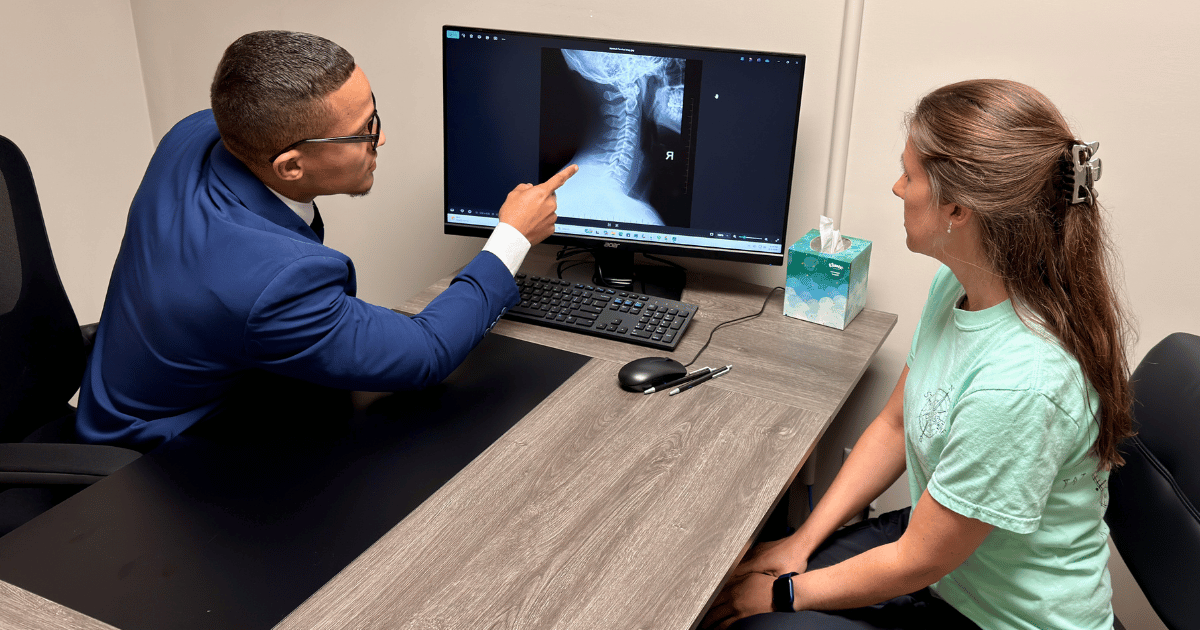
When you experience neck discomfort, back pain, or other musculoskeletal concerns, you may have questions about what is causing your symptoms. In certain situations, an X-ray can provide useful information about the bones and alignment of the spine.
At Victory Spinal Care in Melbourne, Florida, X-ray imaging may be considered when clinically appropriate to help evaluate specific spinal concerns. Whether imaging is needed depends on your symptoms, health history, physical examination, and the information required to guide your care.
An X-ray is not necessary for every patient. The purpose of imaging is to answer a relevant clinical question—not simply to obtain a picture of the spine. Your healthcare provider should explain why an examination is being recommended and how the findings may influence your care decisions.
An X-ray is a medical imaging test that uses a small amount of ionizing radiation to create images of structures inside the body. Different tissues absorb X-rays differently, allowing bones and certain structural changes to appear on the resulting image.
The type of information available depends on the area being examined and the views obtained.
An X-ray does not show every cause of pain. It is not designed to provide detailed images of spinal nerves, discs, muscles, ligaments, or other soft tissues. Depending on the clinical question, an MRI, CT scan, or another diagnostic test may be more appropriate.
A healthcare professional may recommend spinal X-rays when the results could help answer a specific clinical question.
Depending on the circumstances, imaging may be considered when there is concern about:
Suspected Bone Injury
Following certain injuries or trauma, X-rays may help evaluate the bones for fractures or other abnormalities. The appropriate imaging test depends on the nature and severity of the injury.
Structural Changes in the Spine
X-rays can help visualize certain changes in the shape, position, or appearance of the vertebrae. These findings must be interpreted in the context of your symptoms and clinical examination.
Specific Spinal Conditions
When a particular condition is suspected, imaging may help support an evaluation or guide decisions about further testing. An X-ray alone may not be enough to establish a diagnosis.
Symptoms That Require Further Evaluation
Some symptoms warrant additional assessment before a treatment plan is recommended. Your healthcare provider can determine whether imaging is appropriate or whether referral for another examination is needed.
Routine imaging is not recommended for every episode of uncomplicated neck or back pain. Evidence-based imaging guidelines emphasize choosing tests based on the patient’s clinical situation, rather than automatically ordering X-rays for everyone with spinal discomfort.
Spinal X-rays primarily provide information about bones and certain structural features. Depending on the area imaged, they may help identify:
However, an X-ray finding does not necessarily explain your symptoms. Some people have visible degenerative changes without significant pain, while others experience pain without obvious abnormalities on an X-ray.
A healthcare professional should interpret the images alongside your medical history and examination. If the findings do not answer the clinical question, further testing or referral may be necessary.
If an X-ray is recommended, the process is generally straightforward. The exact procedure depends on the body area being examined and the type of imaging required.
1. Review of Your Health Information
Before imaging, the healthcare professional should establish why the examination is needed and review relevant information, including any previous imaging and your current symptoms.
Tell the provider if you are pregnant, might be pregnant, or have other circumstances that may affect imaging decisions.
2. Positioning for the Images
You may be asked to stand, sit, or lie in a particular position. The imaging professional will position you to obtain the views needed for the examination.
You may need to remain still briefly while each image is captured.
3. Image Acquisition
The X-ray machine directs a controlled beam through the area being examined to create an image. The procedure itself is generally quick, although positioning and obtaining multiple views may take additional time.
You will not feel the X-rays passing through your body.
4. Review and Next Steps
The images must be reviewed and interpreted by an appropriately qualified professional. Your healthcare provider can then discuss the findings, explain any limitations, and determine whether additional evaluation or a change in your care plan is needed.
The availability of on-site imaging, the person responsible for image interpretation, and the process for obtaining a formal radiology report should be confirmed with the practice before your appointment.
Medical X-rays are widely used when the expected clinical benefit justifies the exposure to radiation. The radiation dose from a particular examination depends on the body area, imaging technique, and number of views.
Although the radiation exposure from many routine X-ray examinations is relatively low, it is not zero. The goal is to use imaging only when appropriate and to obtain the necessary information with the lowest reasonable radiation exposure.
Important considerations include:
Your healthcare provider can explain the expected benefits, potential risks, and alternatives before the examination.
Because Victory Spinal Care focuses on upper cervical chiropractic care, patients may have questions about whether X-rays are needed to evaluate the upper neck.
Imaging may be appropriate in certain circumstances, but it should not be automatic. The decision should be based on the patient’s history, examination findings, and a specific clinical question that the images are expected to answer.
When imaging is appropriate, X-rays may provide information about the bones and certain structural features of the cervical spine. They do not directly measure nerve function, prove that a vertebra is causing symptoms, or establish that a particular chiropractic adjustment is necessary.
Imaging findings should be interpreted carefully, and the limitations of the test should be explained. If a different examination or referral is needed, that should be considered before proceeding with care.
Victory Spinal Care serves Melbourne and surrounding Brevard County communities, including Palm Bay, Viera, Suntree, and West Melbourne.
Dr. Javier Canales-Díaz, D.C., provides upper cervical chiropractic care and evaluates patients based on their individual concerns and clinical circumstances. When diagnostic imaging is being considered, the reason for the examination should be explained, including how the results may affect care recommendations.
If you are considering an appointment, you can contact the practice to ask about X-ray availability, the type of imaging offered, and whether an imaging examination may be appropriate for your situation.
Victory Spinal Care
301 W Fee Ave
Melbourne, FL 32901
Phone: (321) 288-1455
Serving Melbourne, Palm Bay, Viera, Suntree, West Melbourne, and surrounding Brevard County communities.
Q. Do I need an X-ray before receiving upper cervical chiropractic care?
A. Not necessarily. Imaging decisions should be based on your symptoms, health history, examination findings, and whether the results are likely to influence clinical decisions. Routine X-rays are not necessary for every patient, and your provider should explain the reason for recommending one.
Q. Can an X-ray show a pinched nerve or herniated disc?
A. An X-ray does not directly show most pinched nerves or herniated discs. It primarily shows bones and certain structural features. Depending on your symptoms and the clinical question, an MRI or another diagnostic test may be more appropriate.
Q. Can an X-ray identify the cause of my neck or back pain?
A. Sometimes an X-ray can identify a relevant bone abnormality, but it cannot determine the cause of every type of neck or back pain. Imaging findings must be considered alongside your symptoms, medical history, and examination.
Q. Are spinal X-rays safe?
A. X-rays are generally considered appropriate when there is a clear medical reason for obtaining them. They involve ionizing radiation, so the potential benefit should outweigh the risk. Tell your provider if you are pregnant or may be pregnant, and share information about previous imaging.
Q. How long does an X-ray examination take?
A. The actual image capture is usually quick. The overall appointment may take longer depending on positioning, the number of images required, and the clinic’s procedures. Ask the practice about its specific process when scheduling.
Q. Does Victory Spinal Care offer on-site X-rays?
A. Contact Victory Spinal Care at (321) 288-1455 to confirm current imaging availability, the types of X-rays offered, and whether an appointment or referral is needed.
If you’re considering an X-ray as part of a spinal or musculoskeletal evaluation, understanding why the test is being recommended can help you make an informed decision.
Contact Victory Spinal Care in Melbourne, Florida, to ask about the imaging services available and discuss the next appropriate step for your situation.
Call (321) 288-1455 to contact Victory Spinal Care.
301 W Fee Ave, Melbourne, FL 32901
Serving Melbourne and surrounding Brevard County communities.
This page is intended for general educational purposes only and is not a substitute for professional medical advice, diagnosis, or treatment. The need for imaging depends on individual clinical circumstances. Consult a qualified healthcare professional about your symptoms and diagnostic options. Seek urgent medical care for severe or rapidly worsening symptoms.
Victory Spinal Care provides personalized upper cervical chiropractic care in Melbourne, Florida. Dr. Javier Canales-Díaz is committed to helping patients understand their spinal health and explore appropriate care options.
Service Areas: Melbourne, Palm Bay, Viera, Suntree, West Melbourne, and surrounding communities in Brevard County, Florida.
Copyright 2016-2025 Victory Spinal Care. All Rights Reserved.