
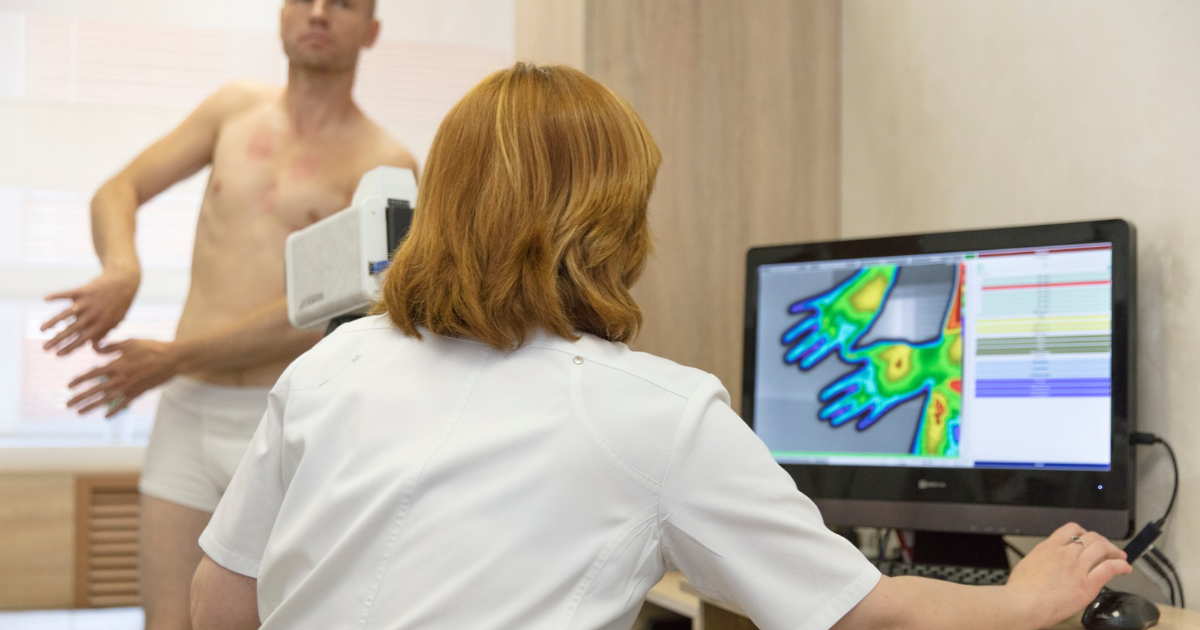
Every person’s body produces heat, and the temperature at the skin’s surface can vary from one area to another. Infrared thermography is a method of measuring or visualizing these temperature differences without using ionizing radiation.
At Victory Spinal Care in Melbourne, Florida, thermography examination is among the assessment services available to patients. Depending on the technique used, thermal measurements may provide additional information for discussion alongside a patient’s health history, symptoms, and physical examination.
Thermography does not independently diagnose the cause of pain or determine whether chiropractic treatment is necessary. Understanding what the examination measures—and its limitations—is an important part of making informed decisions about your care.
Thermography is a technique that uses infrared sensors or cameras to detect heat emitted from the skin’s surface. The information may be displayed as temperature readings, a graph, or a thermal image, depending on the equipment.
In some chiropractic settings, practitioners use paraspinal thermography to measure temperature patterns along the back or neck. These readings may be compared across different areas or, in some systems, recorded over time.
Surface temperature can be influenced by many factors, including room temperature, recent physical activity, clothing, skin conditions, blood flow, and the body’s normal temperature regulation.
Although thermal scanning is sometimes described as a way to assess nervous system activity, skin temperature patterns do not provide a direct measurement of spinal nerve function. Thermography alone cannot establish the presence of a spinal misalignment, nerve interference, or a specific neurological disorder.
Infrared thermography detects thermal radiation emitted from the surface of the body. The equipment converts this information into temperature measurements or visual patterns.
A typical assessment may involve the following:
The appearance of a temperature difference does not automatically indicate disease or a problem with spinal alignment.
A clinically meaningful interpretation requires an understanding of the measurement technique, environmental conditions, and the limitations of the equipment.
Some chiropractic practitioners incorporate thermal scanning into their assessment process as an additional source of observational information.
Depending on the equipment and clinical approach, it may be used to:
Observe Skin Temperature Differences
Infrared sensors can identify temperature variations at the skin’s surface. These differences may be influenced by normal physiology, environmental factors, and various health-related circumstances.
Document Measurements During an Evaluation
A practitioner may record thermal readings as part of the examination record. The usefulness of comparing measurements over time depends on the consistency of the technique and whether changes have established clinical significance.
Support a Broader Discussion of Examination Findings
Thermal measurements may prompt questions or discussion, but they should not replace a medical history, physical examination, or validated diagnostic testing.
Explain the Assessment Process to Patients
When used, the practitioner can explain what the device measures, how the readings are displayed, and what conclusions can reasonably be drawn.
Important: Current evidence does not establish chiropractic paraspinal thermography as a reliable standalone test for diagnosing spinal dysfunction or determining the need for an adjustment. Treatment decisions should not depend solely on thermal scan findings.
The exact process depends on the equipment used at Victory Spinal Care. In general, an infrared thermal assessment may involve the following steps.
1. Review of Your Health History
Your practitioner begins by discussing your symptoms, health history, previous injuries, and concerns. This information helps determine which assessments may be appropriate.
2. Preparation for Thermal Measurements
You may be asked to position yourself so the relevant area can be assessed. Depending on the equipment, the practitioner may provide instructions about clothing, positioning, or allowing the skin to adjust to the room environment.
3. Infrared Scanning
A thermal sensor or camera is used to collect surface temperature measurements. The process generally does not require needles, injections, or physical pressure from the scanning device.
4. Discussion of Findings
The practitioner may show you the readings and explain what was measured. Any findings should be discussed in the context of your overall evaluation, rather than treated as a definitive diagnosis.
5. Appropriate Next Steps
If your symptoms or examination findings indicate the need for further evaluation, another diagnostic test or referral may be recommended.
The exact procedure, device, and interpretation method should be confirmed with Victory Spinal Care before publication of this page.
Infrared thermography is generally noninvasive. Passive infrared cameras and sensors detect heat emitted from the body rather than exposing the patient to ionizing radiation.
For a typical passive thermal scan:
These characteristics describe passive infrared thermography. They should not be assumed to apply to every device marketed as a thermal or neurological assessment system.
The main concern with thermography is often not the scanning process itself, but the possibility of overinterpreting results. A temperature pattern should not be used to diagnose a serious condition or reassure someone that a medical problem has been ruled out.
Upper cervical chiropractic care focuses on the upper region of the neck, including the atlas (C1) and axis (C2) vertebrae.
Some upper cervical chiropractic approaches incorporate paraspinal thermal scanning as part of their examination methods. However, the relationship between skin temperature patterns, spinal alignment, and clinical symptoms has not been established sufficiently to support thermography as a definitive diagnostic tool.
Thermography cannot directly show vertebral position, measure nerve compression, or confirm that an upper cervical adjustment is required.
At Victory Spinal Care, any thermal findings should be considered alongside the patient’s history, relevant physical findings, and other clinically appropriate assessments.
Patients are encouraged to ask what the examination measures, how the findings will be interpreted, and whether those findings are supported by validated diagnostic methods.
Victory Spinal Care in Melbourne, Florida, provides upper cervical chiropractic care and related examination services under the care of Dr. Javier Canales-Díaz, D.C.
A thermography examination may be discussed as part of the practice’s assessment process, depending on your individual circumstances and the equipment available.
Our goal is to help patients understand the services being offered, ask informed questions, and participate in decisions about their care.
If you would like to learn more about thermography examinations, contact Victory Spinal Care to ask about the specific scanning method used and what to expect during an appointment.
Serving Melbourne, Palm Bay, Viera, Suntree, West Melbourne, and surrounding Brevard County communities.
Q. What is a thermography examination in chiropractic care?
A. A thermography examination uses infrared sensors or cameras to measure temperature patterns at the skin’s surface. Some chiropractic practitioners include thermal scanning as part of an assessment, but the results should not be treated as a standalone diagnosis of spinal or neurological problems.
Q. Is thermography the same as an X-ray?
A. No. Thermography measures infrared radiation emitted from the skin, while an X-ray uses ionizing radiation to create images of internal structures, particularly bones. The two methods provide different types of information and are not interchangeable.
Q. Can thermography detect a pinched nerve?
A. Thermography cannot reliably diagnose a pinched nerve on its own. Nerve compression is evaluated through a patient’s symptoms, clinical examination, and, when appropriate, other diagnostic tests such as MRI or electrodiagnostic studies.
Q. Does thermography show whether my spine is properly aligned?
A. No. Thermography does not directly image the vertebrae or measure spinal alignment. A temperature difference does not establish that a spinal misalignment is present or that chiropractic treatment is required.
Q. Is a thermography examination painful?
A. Passive infrared thermography is generally painless and noninvasive. The equipment detects heat emitted from the skin, usually without the need for injections or physical pressure.
Q. Do I need a thermography examination before upper cervical chiropractic care?
A. Not necessarily. Whether a particular assessment is appropriate depends on your clinical circumstances and the practitioner’s examination approach. Thermography is not an established requirement for every patient receiving chiropractic care.
Understanding the purpose of an examination can help you make informed decisions about your care.
If you have questions about thermography or other assessment services at Victory Spinal Care, our Melbourne office can provide information about the examination process and available appointment options.
Call Victory Spinal Care at (321) 288-1455 to learn more.
Victory Spinal Care
301 W Fee Ave, Melbourne, FL 32901
Serving Melbourne and surrounding Brevard County communities.
This page provides general educational information and is not a substitute for professional medical advice, diagnosis, or treatment. Infrared thermography measures surface temperature patterns and is not an established standalone diagnostic test for spinal misalignment, nerve compression, or neurological disease. Patients with persistent, severe, or worsening symptoms should seek appropriate medical evaluation.
Victory Spinal Care provides personalized upper cervical chiropractic care in Melbourne, Florida. Dr. Javier Canales-Díaz is committed to helping patients understand their spinal health and explore appropriate care options.
Service Areas: Melbourne, Palm Bay, Viera, Suntree, West Melbourne, and surrounding communities in Brevard County, Florida.
Copyright 2016-2025 Victory Spinal Care. All Rights Reserved.