
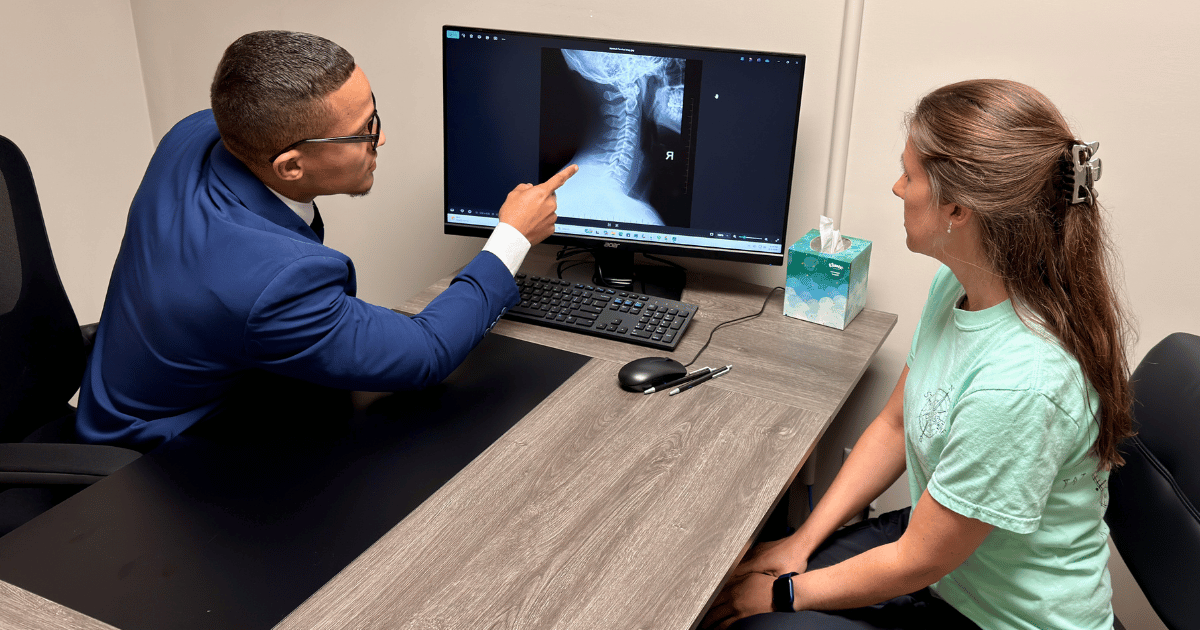
The upper cervical spine is the top portion of your neck, where the skull meets the first two vertebrae. This area plays an important role in supporting your head and allowing neck movement.
At Victory Spinal Care, we provide upper cervical chiropractic care in Melbourne, Florida, with an individualized approach that begins with understanding your health history, symptoms, and movement concerns. Our goal is to evaluate whether chiropractic care may be appropriate for your needs and explain your options before recommending a care plan.
Whether you’re experiencing neck discomfort, stiffness, or concerns about how your neck moves, a professional evaluation can help determine the next appropriate step.
Looking for upper cervical chiropractic care in Brevard County? Victory Spinal Care welcomes inquiries from Melbourne, Palm Bay, Viera, Suntree, West Melbourne, and surrounding communities.
Upper cervical chiropractic care is a specialized approach to chiropractic care that focuses on the upper portion of the cervical spine. This region includes the first two neck vertebrae, commonly called the atlas (C1) and axis (C2).
These vertebrae help support the head and allow a range of head and neck movements. The surrounding joints, muscles, ligaments, and nerves also contribute to how this area functions.
Depending on the practitioner’s training and approach, upper cervical care may involve a detailed assessment of neck movement, posture, medical history, and other relevant findings. If chiropractic treatment is appropriate, the practitioner will explain the proposed technique and its potential benefits and risks.
It is important to understand that upper cervical chiropractic care is not a treatment for every health condition. Evidence for spinal manipulation varies by condition and technique, and claims that upper cervical adjustments correct underlying causes of unrelated neurological or systemic diseases are not established by strong clinical evidence.
The upper cervical region contributes to head support, neck mobility, and coordination between the head and neck. Discomfort in this area may affect everyday activities, including looking over your shoulder, working at a computer, driving, or sleeping comfortably.
People may seek an evaluation for concerns such as:
These symptoms can have many possible causes. An evaluation is not a guarantee that the upper cervical spine is responsible, and symptoms such as headaches or dizziness may require assessment by another healthcare professional.
Your first appointment should focus on understanding your concerns and determining whether care is appropriate. The process may include the following steps.
1. Health History and Discussion
Your chiropractor will ask about your symptoms, when they began, what makes them better or worse, previous injuries, medical conditions, medications, and any relevant diagnostic testing.
Sharing a complete and accurate health history helps the practitioner identify factors that may affect the safety or suitability of chiropractic care.
2. Physical Examination
Depending on your symptoms, an examination may include posture, neck movement, range of motion, and other appropriate physical assessments. The practitioner may also consider whether your symptoms suggest the need for medical evaluation or referral.
3. Review of Findings
Your practitioner should explain the relevant findings in understandable language, discuss what they may mean, and outline reasonable options. Not every symptom originates in the neck, and not every person is a suitable candidate for chiropractic treatment.
4. Individualised Care Recommendations
If chiropractic care is appropriate, the recommendations should reflect your examination findings, health history, goals, and preferences. Your practitioner should explain the proposed approach, possible risks, expected limitations, and when your progress will be reassessed.
If another type of care is more appropriate, a referral may be recommended.
Some people seek chiropractic care to help manage certain musculoskeletal concerns, including neck pain. Research suggests that spinal manipulation may help some people with neck pain, but results vary, and evidence about general spinal manipulation should not be interpreted as proof that every upper cervical technique is effective for every condition.
Depending on the individual and the care provided, potential goals may include:
Upper cervical chiropractic care is not a guaranteed solution. It has not been established as a cure for neurological disorders, hearing loss, tinnitus, digestive diseases, high blood pressure, or other systemic conditions. It should not replace prescribed medication, medical treatment, or evaluation by an appropriate healthcare professional.
Whether chiropractic care is appropriate depends on your symptoms, health history, examination findings, and individual risk factors.
An evaluation may be worth discussing if you have a musculoskeletal concern involving your neck and want to understand your care options. However, some conditions require a different approach, additional testing, or medical assessment before chiropractic treatment is considered.
Make sure your chiropractor knows about any history of significant neck injury, osteoporosis, spinal instability, cancer, infection, bleeding disorders, vascular conditions, neurological symptoms, or recent surgery. These and other factors may affect the safety or suitability of particular techniques.
Seek urgent medical care for new or severe symptoms such as sudden weakness or numbness, difficulty speaking, facial drooping, sudden vision changes, severe unexplained headache, fainting, or new difficulty walking or coordinating movement. Do not assume these symptoms are caused by a neck alignment problem.
At Victory Spinal Care in Melbourne, Florida, Dr. Javier Canales-Díaz, D.C., provides upper cervical chiropractic care with attention to each patient’s history, concerns, and examination findings.
Our approach is centered on helping you understand your options and determining whether chiropractic care is appropriate for your situation. Recommendations should be individualized rather than based on a one-size-fits-all protocol.
During your visit, you can expect an opportunity to discuss your concerns, ask questions, and understand the reasoning behind any proposed care plan.
We serve patients in Melbourne and surrounding Brevard County communities, including Palm Bay, Viera, Suntree, and West Melbourne.
Q. What is the difference between upper cervical chiropractic care and general chiropractic care?
A. Upper cervical chiropractic care focuses on the upper portion of the neck, particularly the first two cervical vertebrae. General chiropractic care may address a broader range of spinal and musculoskeletal concerns. Techniques and evaluation methods vary among practitioners.
Q. Can upper cervical chiropractic care help with neck pain?
A. Some forms of spinal manipulation may help certain people with neck pain, but results vary. Whether upper cervical care is appropriate depends on the cause of your symptoms, your health history, and your examination findings. Your chiropractor should explain the evidence, potential risks, and alternatives.
Q. Can upper cervical chiropractic care treat migraines, vertigo, or tinnitus?
A. These symptoms can have different causes and should not automatically be attributed to the neck. Evidence does not establish upper cervical chiropractic care as a treatment or cure for all of these conditions. A medical evaluation may be important, particularly for new, persistent, or worsening symptoms.
Q. Will I need an X-ray before receiving upper cervical chiropractic care?
A. Not necessarily. Imaging decisions should be based on your history, examination, and clinical need. X-rays involve radiation and cannot show every type of spinal or neurological problem. Your practitioner should explain why imaging is being recommended and whether other options are appropriate.
Q. Is upper cervical chiropractic care safe?
A. Safety depends on the person’s health, the technique used, and the clinical circumstances. Temporary soreness, stiffness, or headache can occur after spinal manipulation. Rare but serious complications have been reported. Share your medical history and ask about the risks, alternatives, and any precautions relevant to you before proceeding.
Q. How many visits will I need?
A. There is no single schedule that is appropriate for everyone. Visit recommendations should depend on your individual situation, treatment goals, response to care, and the evidence supporting the proposed approach. Your progress should be reassessed, and the plan adjusted when appropriate
If you’re considering upper cervical chiropractic care in Melbourne, FL, start with a conversation about your concerns and goals. Victory Spinal Care can help you understand the evaluation process and whether an appointment may be appropriate for your situation.
Call Victory Spinal Care at (321) 288-1455 to ask a question or inquire about scheduling.
Victory Spinal Care
301 W Fee Ave, Melbourne, FL 32901
Serving Melbourne, Palm Bay, Viera, Suntree, West Melbourne, and surrounding Brevard County communities.
The information on this page is provided for general educational purposes only and is not a substitute for professional medical advice, diagnosis, or treatment. Individual results vary, and chiropractic care is not appropriate for every condition or patient. Consult a qualified healthcare professional about your symptoms and treatment options. Seek urgent medical attention for emergency symptoms.
These references support the general educational and safety statements on this page. They do not establish that every upper cervical chiropractic technique is effective for every condition.
1. National Center for Complementary and Integrative Health (NCCIH), Spinal Manipulation: What You Need To Know:
https://www.nccih.nih.gov/health/spinal-manipulation-what-you-need-to-know
2. NCCIH, 4 Things To Know About Spinal Manipulation for Low-Back Pain: https://www.nccih.nih.gov/health/tips/things-to-know-about-spinal-manipulation-for-lowback-pain
3. Cochrane, Manipulation and Mobilisation for Neck Disorders: https://www.cochrane.org/evidence/CD004249_manipulation-and-mobilisation-neck-disorders
4.RadiologyInfo.org, Cervical Neck Pain or Cervical Radiculopathy: RadiologyInfo.org, Cervical Neck Pain or Cervical Radiculopathy:
https://www.radiologyinfo.org/info/acs-cervical-neck-pain-radiculopathy
Victory Spinal Care provides personalized upper cervical chiropractic care in Melbourne, Florida. Dr. Javier Canales-Díaz is committed to helping patients understand their spinal health and explore appropriate care options.
Service Areas: Melbourne, Palm Bay, Viera, Suntree, West Melbourne, and surrounding communities in Brevard County, Florida.
Copyright 2016-2025 Victory Spinal Care. All Rights Reserved.